 |
My Account | Shopping Cart | ||||||||
 |
|||||||||
|
Sunex InnovationSunex is a pioneer in developing innovative optics for digital imaging applications. Over the years we have developed an extensive library of proprietary lens designs that optimize the performance of digital imaging systems. To deliver the best value to our customers, we strive to achieve the best overall balance between performance, size, cost and manufacturability. Examples of our innovative designs include:
Miniature Fisheye Lenses
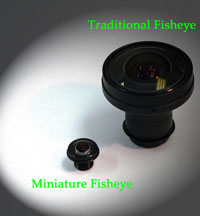
Traditional fisheye lenses are bulky and expensive to manufacture. Furthermore, their performance are limited by the poor off-axis resolution and chromatic aberrations. In response to these shortcomings, we created a series of miniature fisheye lenses using specially formulated high-index materials. Our miniature fisheye lenses are a fraction of the size and weight of other fisheye lenses. They provide excellent off-axis imaging quality with minimal amount of chromatic aberrations. Because of this innovative design approach, we are able to offer these lenses at drastic lower prices than other fisheye lenses. This technology has enabled our customers to develop a range of new cameras taking advantage of the low-cost multi-megapixel CMOS imagers.
NoGhost™ lenses for HDR imaging applicationsHDR (high dynamic range) imagers are capable of capturing light intensity variations up to six or more orders of magnitude within the same image frame (~120db). This puts a very demanding requirement on lens performance. Sunex has developed design expertise, process know-hows and super-clean manufacturing facilities to eliminate or minimize optical noise (such as ghosts, flare, star bursts, spurious images) in lenses for high-performance applications. Lenses designed and manufactured with this process are known as NoGhost™ lenses. The following comparison demonstrates the advantages of NoGhost™ lens:
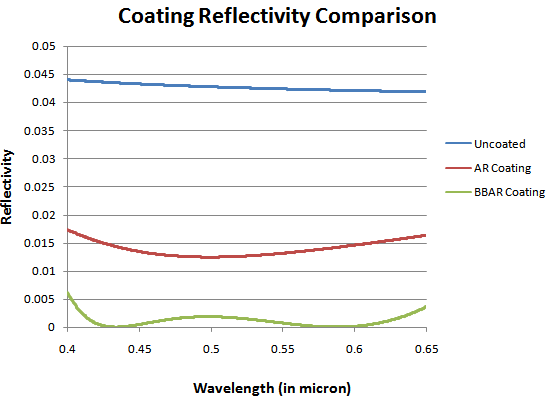
The following sections describes some of our design and process technologies for NoGhost™ lenses. Design expertiseGhost images are caused by multiple reflections between the surfaces of the optical system including the lens elements surfaces, filter surfaces and CMOS imager cover glass surfaces. Before a ray reaches the imager active surface, it must pass thru all these optical surfaces. At each optical surface, a small fraction of ray energy will be reflected backward due to the law of reflection. This reflected ray can be reflected again by some other optical surfaces forming "ghost" images on the imager active surface. We have developed appropriate tools to simulate these images during design stage. High performance coatingsWays to minimize or eliminate "offensive" ghosts including choosing proper optical designs defocusing the ghost images, and by using highly efficient coatings on the lens/filter surfaces. Sunex's BBAR coating technology enables further drastic reduction by reducing the surface reflectivity to as low as 0.3% per surface. The following curve shows the nominal reflectivity of each AR coating:
Processes and Class 100 manufacturing facilities
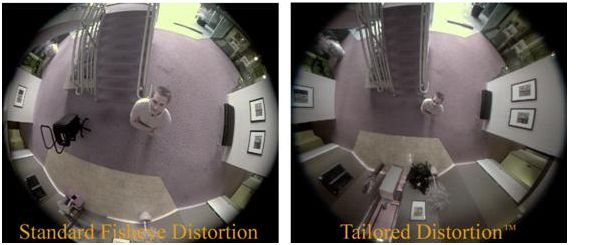
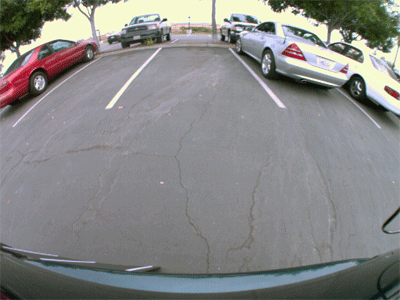
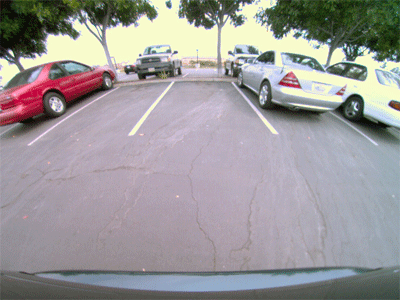
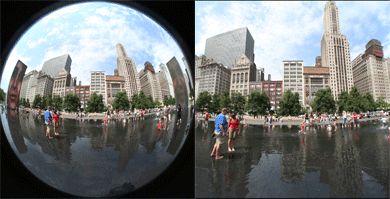
Tailored Distortion®: Distortion Correction at Speed of LightSuper wide-angle lenses and fisheye lenses have pronounced barrel distortion. When viewing a flat object, off-axis features are "squeezed" significantly relative to the on-axis ones. This reduces the effective off-axis resolutions. For many applications, it is an undesirable effect. It is possible to post-processing the image to reduce this effect. However post-processing in software reduces the image quality because the missing off-axis information must now be interpolated. We created a new class of super wide-angle and fisheye designs using high precision aspherical elements to reduce the off-axis "squeezing" optically. Comparing with standard f-theta designs, the distortion reduction is on the order of 50%. This allows off-axis objects to be imaged with more pixels. This technology has brought significant commercial benefits to security and automotive back-up cameras (request a technical article on Tailored Distortion theory). Tailored distortion lenses for security applicationsLike a traditional fisheye lens, Tailored Distortiontion™ is ideal for security applications where an ultra-wide field of view is required. Tailored Distortion offers some key advantages over a traditional fisheye, however. This is true particularly for 360º surveillance cameras or in applications where post-processing or dewarping of the image is either unneeded or undesirable. The reason for this is two-fold. First, traditional fisheye lenses suffer from compression of the image at the edges. Since there is simply more area to cover at the periphery of the imaged area, the edge of the image becomes compressed, with less pixels available per unit area. This can be a critical issue for 360º imaging applications, since the areas of interest are usually located at the edges of the image (see example below). Tailored Distortion largely solves this situation by intentionally compressing the center of the image, leaving more pixels available at the edge. This results in high resolution throughout the image. Tailored Distortion lenses also behave in a predictable way, so that post-dewarping is still an option, and in fact delivers more uniform and higher resolution across the entire image than a comparable, traditional fisheye lens. The second primary advantage of Tailored Distortion is that it provides a more rectilinear image. The result is an image that maintains a more realistic perspective that is much less disorienting than traditional fisheye images. This means that many applications, such as doorbell phones or 360º surveillance may not require any software dewarping at all. And since Tailored Distortion is all done optically, there is no software manipulation of the actual image, thus avoiding many of the issues sometimes associated with post-processing. Automotive applications:The following is a comparison between two backup camera lenses. The technical advantage of Tailored Distortion is clear.
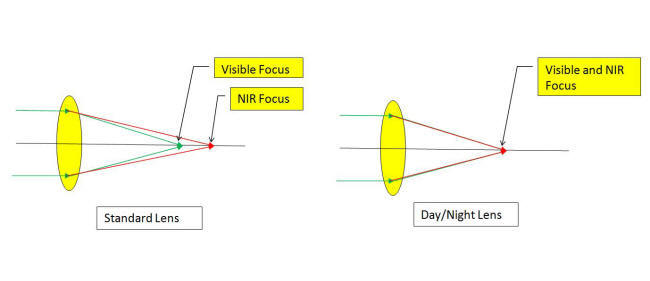
Boresight StablizationA typical lens assembly consists of several lens elements inside a cylindrical barrel. Due to the mechanical clearance requirement, the internal element diameters must be smaller than the barrel internal diameter. This creates the potential risk that the elements may shift laterally under strenuous conditions thus causing a shift in the lens bore sight. This risk can be devastating for certain applications. To eliminate this risk, we have created an opto-mechanical design process that allows us evaluate this risk on a per element basis, and to "glue" the lens elements laterally. Opto-mechanical designs created by this process are fully compatible with our manufacturing process. Day/night LensesDue to the chromatic aberrations most lenses can only be focused for either visible OR NIR wavelength, not both spectral regions simultaneously. Using advanced design technique and unique optical materials, we have created a series of day/night lenses that are chromatic corrected for the entire visible-NIR spectral range. These lenses are in focus for both visible and NIR at the same focus distances. Sunex Day/Night lenses have enabled our customers to produce more functional cameras for day/night security and surveillance applications. Visit Day/Night products page. Dewarping Algorithms
Images from super wide-angle and fisheye lenses have significant amount of barrel distortion. Post-processing can "dewarped" these images and make them for useful or pleasant for intended applications. However, most existing algorithms makes unrealistic assumptions about lens behaviors. Sunex has developed a new set of dewarping algorithms based on the real-world lens behaviors from our extensive experience in lens manufacturing. These algorithms are powerful and flexible enough to allow the adjustment of lens distortion interactively (click here for a demo).
Sunex Technology PartnersSunex has developed partnership with a wide range of complementary technology providers to offer complete solutions based on the market needs. Learn more about Sunex partners. |
||||||||
|
|||||||||