|
|
Return to Part 1 of this article
Multi-element lenses
Singlet lens performance is limited by its aberrations. To achieve better
optical performance, multi-element lens designs are required. A
multi-element lens uses a combination of various singlet elements to minimize
the overall aberrations. This is possible because some of the singlet element
may have positive aberrations while others may have negative aberrations.
By choosing the element combination judiciously, the overall aberrations can be
minimized to an acceptable level. The lens elements can be made of different
materials, and are of different shapes, and different surface curvatures.
The process of determining the optimal lens element configuration is performed
by a lens designer with the aid of appropriate computer software. The following
is a list of well-known lens configurations that provide greatly improved
performance for the chosen applications.
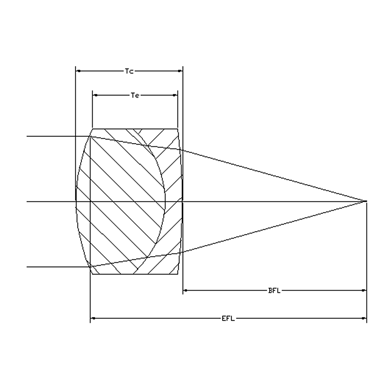
- Achromatic doublets
- An achromatic doublet is made of two singlet lens
elements, often cemented together as one unit. This configuration can
eliminate the spherical and longitudinal aberration completely. In fact,
diffraction limited performance can be achieved in many cases. We
provide a range of diffraction-limited doublet lenses that were optimized
for the visible spectrum. You can also use our
lens design wizard to design custom doublet
lenses. Their major limitations are: (1) Off-axis performance of achromatic
doublets deteriorates rapidly with the field of view, and (2) The f/# of
achromatic doublet lenses are limited to about f/3 or higher.
- Achromatic doublet with matching aplanatic meniscus lens
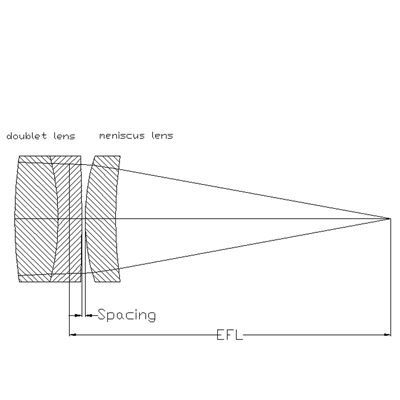
- By adding a properly designed meniscus lens, it is possible to
extend the relative aperture o of a doublet by the index of refraction of
the meniscus lens. A meniscus lens can be designed to reduce the
overall focal length without introducing additional spherical aberration.
Such a meniscus lens is known as aplanatic form. We provide a list of
standard
aplanatic meniscus lenses. You can also use our
lens design wizard to create custom aplanatic
meniscus lenses. Because the meniscus lens is not achromatized, the
overall system will have longitudinal chromatic aberration.
- Cooke triplet lenses
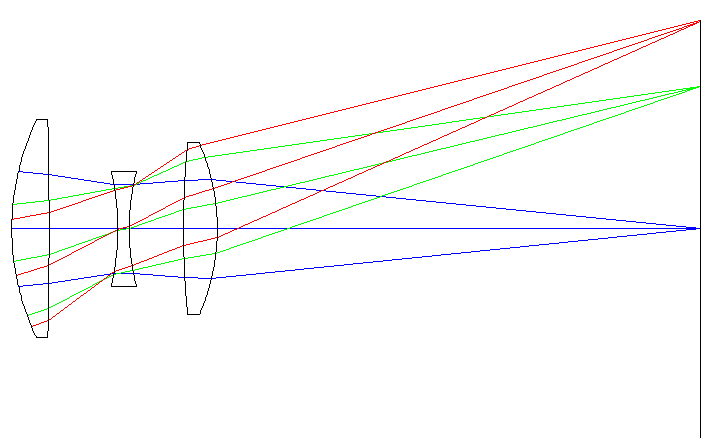
- All above lens configurations provide improved performance on-axis only.
To achieve good performance both on- and off-axis, more complex lens
forms are required. Cooke triplet is a well-know lens form that
provides good imaging performance over a field of view of +/- 20-25 degrees.
Many consumer grade film cameras use lenses of this type.
- Double Gaussian lens
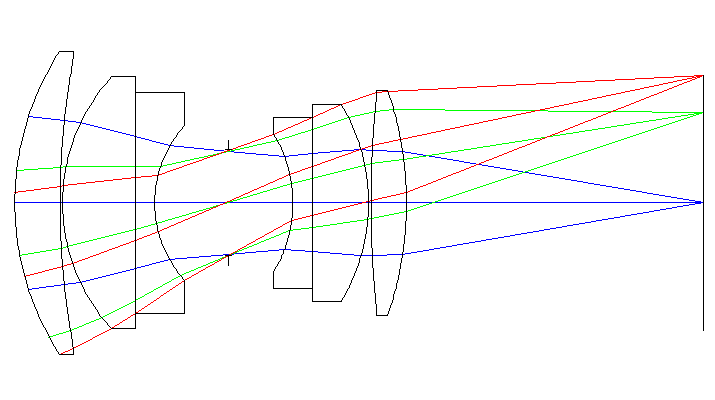
- To achieve higher image quality and to increase the relative aperture
(i.e, lowering the f/#) over a Cooke triplet, a lens form known as
"Double Gaussian" is used. The double Gaussian design uses two
cemented doublets and two companion singlets. This lens form offers
excellent performance over a significant field of view, and the relative
aperture can be as low as F/1.2. Double Gaussian lenses are used in
many SLR lenses, and C-mount lenses for electronic cameras.
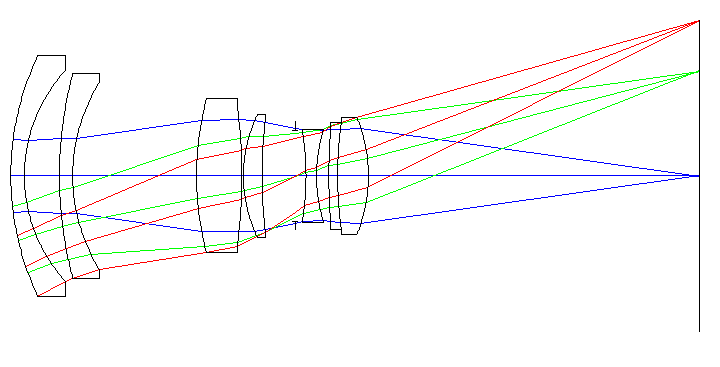
- Reverse telephoto lens
- To provide more field of view coverage, a reverse telephoto lens
type is often used. The front lens group has negative power which
reduces the input field of view. The second group is positive and it
does the focus. With this configuration, the field of view can
be increased to +/-35 degrees. The other advantage of this
configuration is that the system back focal length can be longer than the
effective focal length. This property makes this design form very
attractive to short focal length lenses commonly seen on digital cameras.
- Wide-angle "fisheye" lenses
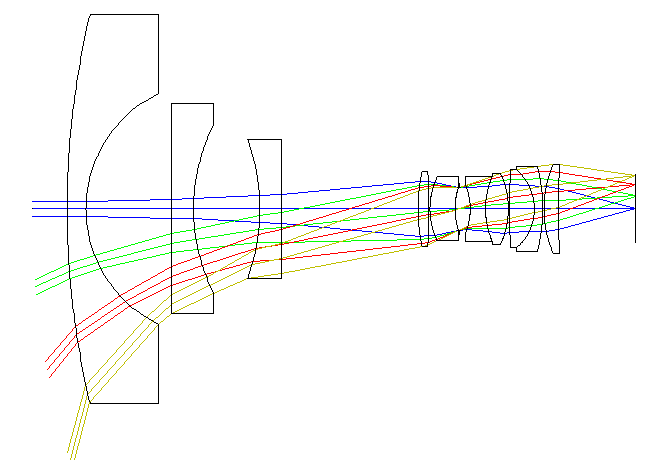
- Wide-angle "fisheye" lenses are sometimes required for security and
surveillance applications. These lenses require significant number of
components. It is also worth noting that the distortion of such lenses can
be very significant.
- Custom lenses
- There is no universal lens design for all applications. To achieve
the best performance/cost trade-offs, many applications will require custom
lens designs. The goal of a custom lens design is to reach an
acceptable performance level for the intended application while minimizing
the cost. Modern lens design software can provide a great deal of
computation power that allows many design configurations to be
evaluated within a short period of time. However, software does
not substitute for experience, judgment and intuition. Manufacturability is
often the key determinant of the success of any optical design. If your
need cannot be met with an off-the-shelf product,
contact us for customized solutions.
|